





The rough-in phase is the stage during which a villa’s structural system—comprising the foundation, columns, beams, load-bearing walls, and floors—is constructed, and it is the most critical process that determines the building’s lifespan, durability, and seismic safety. Since there are no visible indicators of quality—such as exterior cladding or interior details—it is often overlooked; yet a villa’s true quality is shaped during this phase, which lies hidden beneath the plaster. In this article, we discuss the role of formwork systems in the rough construction process and why compliance with earthquake codes is a non-negotiable requirement.
Why Does the Formwork System Determine the Quality of a Villa?
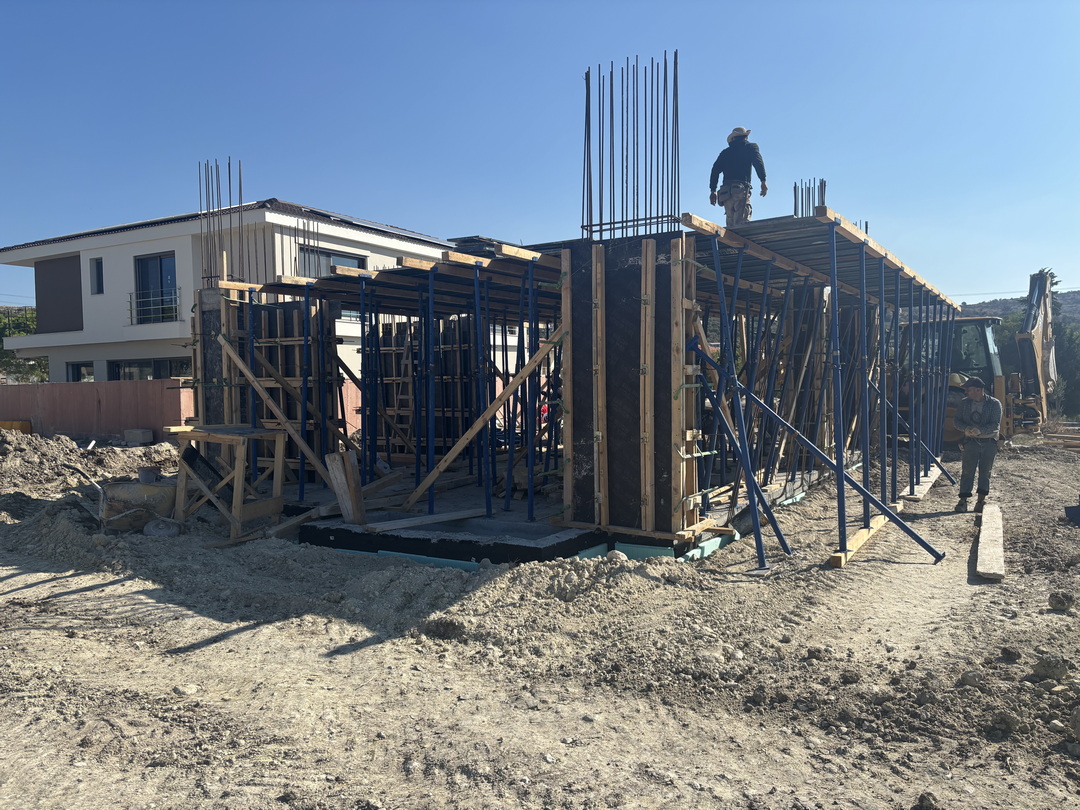
A formwork is a temporary support system that ensures concrete hardens to the desired dimensions and shape; however, the fact that it is “temporary” does not mean it is unimportant. The strength and proper installation of the formwork directly affect the homogeneous placement of concrete, prevent voids or segregation (separation) on the surface, and ultimately ensure that the structural element achieves the strength specified in the project. Dimensional deviations in columns, beams, and shear walls are among the most common problems arising from a loose or non-standard formwork system. Carrying out rough construction work with a formwork system that is divided among different subcontractors and whose standards vary from project to project is a factor that increases this risk.
Compliance with Earthquake Regulations: An Area Where No Compromises Are Made
The Turkish Building Seismic Code requires that the structural systems of all buildings, including villas, be designed and constructed to be earthquake-resistant. This compliance is not limited to the calculations in the structural design; it is a discipline that must be maintained in construction details as well—such as the exact on-site application of reinforcement bar diameter and spacing as specified in the design, careful attention to stirrup densification zones at column-beam joints, maintaining the required concrete cover thickness, and pouring concrete in the correct sequence and using the proper technique. A structural system correctly calculated in the design cannot achieve the anticipated strength if it is implemented on-site in a deficient or careless manner. For this reason, compliance with the seismic code is not a process that ends at the design stage for us, but one that is monitored on-site until the final concrete is poured.
Types of Formwork Systems and Selection Criteria for Villa-Scale Projects
Formwork systems used in the construction industry are classified into different categories based on the materials and construction techniques employed. While wooden formwork is flexible in terms of workability, its reusability is limited; steel formwork is durable and provides a smooth surface finish; aluminum formwork is lightweight and allows for quick assembly; tunnel formwork systems, on the other hand, are preferred especially in large-scale residential projects with repetitive floor plans because they allow walls and slabs to be poured in a single, monolithic pour. In villa-scale projects with distinct floor plans and architectural details, however, the discipline of on-site formwork application and the continuity of the crew are just as critical as the type of material; because each villa is a unique application, not a mass-production process where the same formwork is reused repeatedly.
Our Rough Construction Process at İmerek Yapı
As Imerek Yapı, we have been providing structural construction services since 2017, Without subcontractors, using our own team and our own formwork system We implement this approach. The most significant benefit of this approach is that it allows us to ensure the same standard of formwork quality, the same team discipline, and continuous on-site monitoring for every project. Each stage—rebar tying, formwork installation, and concrete pouring—is inspected according to the details specified by the structural engineer who designed the project. Eliminating the variability associated with subcontractors not only reduces the risk of construction errors but also ensures that the villa’s structural system is built to a consistent standard of quality from start to finish.
Quality Control Points
Checking every stage of the rough construction process ensures that errors are identified on paper rather than on-site. The main checkpoints we monitor are as follows: verifying the alignment between the foundation excavation and the soil study; comparing the diameter and spacing of the rebar with the structural design; checking the dimensions and alignment of the formwork scaffolding, inspecting the rebar and formwork before concrete placement, monitoring vibration and homogeneity during concrete placement, and inspecting the surface and dimensions after formwork removal. Sharing the results of rebar inspections and laboratory tests with building owners prior to concrete pouring is part of İmerek Yapı’s current practice.
Stages Following Rough Construction
Once the rough construction is complete, the next step is to install water and sound insulation on top of the structural system. Waterproofing of foundations and exterior walls must be performed in accordance with the Building Waterproofing Regulation, which came into effect in 2018, and the TS 11758-2 application standard; this topic Waterproofing in Buildings We have detailed this in our article. In villas with multiple stories and spacious living areas, sound insulation is another construction element that directly affects comfort; our approach to this issue Sound Insulation in Villas We discussed this in our article.
The structural framework serves as the foundation upon which all subsequent construction elements—from waterproofing to sound insulation—are built. For this reason, using the correct formwork system and ensuring full compliance with earthquake regulations from the very beginning of the process are working principles on which İmerek Yapı never compromises. If you’d like to discuss the technical details of the rough construction phase of your villa project, Rough Construction You can learn more about our services and contact the İmerek Yapı team by calling +90 545 732 64 44 or emailing [email protected].

