


The question homeowners who want to build a villa pool ask us most often is, “How much will the pool cost?” However, there is no single correct answer to this question, because there are many independent variables that determine the cost of a pool, and these factors come into play with varying degrees of importance from project to project. In this article, we do not provide a specific figure, as material and labor costs fluctuate seasonally, and a price valid at the time of publication can quickly become inaccurate. Instead, as İmerek Yapı, we’ll discuss the key cost drivers in the villa pool projects we’ve completed in Çeşme and Alaçatı, as well as how these factors relate to one another. An on-site assessment is required to establish a clear budget.
Pool Size, Depth, and Geometry
The most significant cost factors are the pool’s square meters and water volume; however, size alone is not the determining factor. A rectangular pool with straight edges, an infinity-edge pool, or an irregularly shaped pool requires different formwork and reinforcement details, even if they have the same square meterage. Design choices such as a seating ledge (shelf), staircase details, or variable depths also entail additional excavation and reinforced concrete work. Therefore, when discussing pool costs, the question of “which geometry” must first be clarified.
Ground Conditions and Excavation
One of the factors that most significantly affects pool costs is the excavation phase, which seems to attract the least attention. On rocky ground, excavation time and equipment requirements increase; on loose or filled soil, however, additional retaining structures or sheet pile walls may be needed to stabilize the side walls of the pool pit. The placement of the pool on sloped terrain also directly determines the need for a retaining wall. Since soil conditions can vary from lot to lot in Çeşme and Alaçatı, we conduct a project-specific assessment and clarify the soil structure before beginning excavation.
Selection of Insulation and Cladding
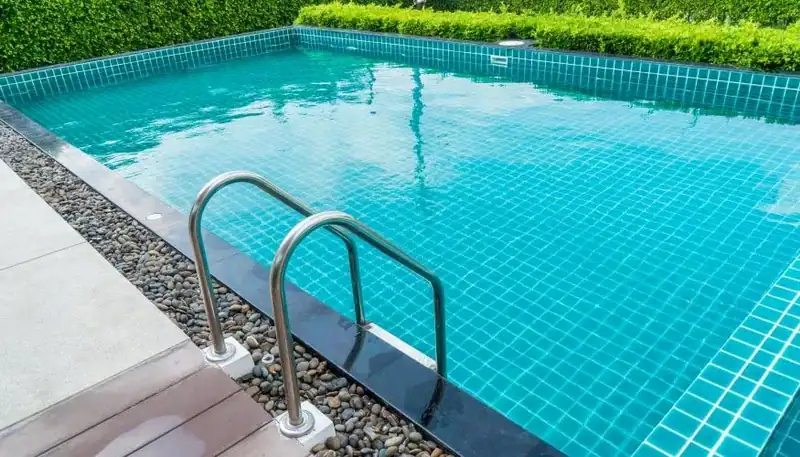
Waterproofing a pool involves working under more challenging conditions than waterproofing a building’s basement, because water exerts constant and direct static pressure. For this reason, the concrete of the pool shell, joint details, and membrane selection must be addressed with the same meticulousness as the zero-tolerance approach we adopt in construction chemicals. On the finishing side, the difference in materials and labor between tile, mosaic, or composite cladding options significantly affects the total cost. Here, too, choosing the material that won’t cause problems in the long run—rather than the cheapest option—saves you from the cost of future removal and replacement.
Filtration, Disinfection, and Mechanical Systems
Just as much as the visible part of the pool, its hidden mechanical infrastructure also determines the cost. The capacity of the filtration pump, the number of skimmers, the heat pump system (if heating is desired), and the disinfection method (chlorine or ozone system) all affect both the initial investment and operating costs. Those who wish to evaluate the impact of these choices on pool costs in greater detail can refer to our article comparing ozone and chlorine systems. It is important to plan these systems during the plumbing phase, before the pool shell is completed; adding a filtration line later on means additional damage to a finished pool.
A villa pool is not a detail added at the end of construction; it is a construction item that must be planned from the structural work phase onward. To get a customized cost estimate for a pool for your project, please contact the İmerek Yapı team: +90 545 732 64 44 / [email protected]

