



The most common mistake in waterproofing is focusing on the question, “Has waterproofing been done or not?” and overlooking the questions, “Which material, at which point, and at what thickness?” However, the material that works on a basement perimeter wall is not the same as the material that works at the junction of the foundation and the perimeter wall; every detail requires its own solution. At İmerek Yapı, we treat waterproofing in our villa projects as a construction element that we plan from the very beginning of the rough construction phase and do not delegate to subcontractors. In this article, we take a closer look at which materials are chosen for which areas and why.
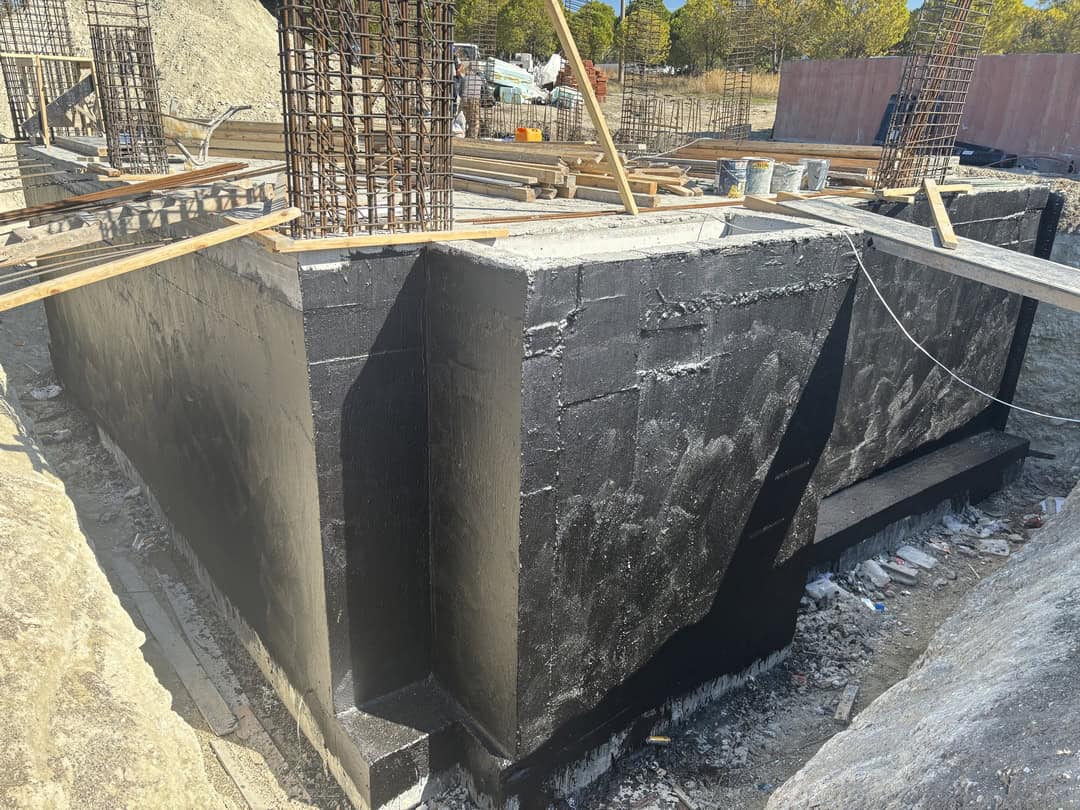
Choosing Materials for Curtain Walls in Bodrum
For curtain walls in direct contact with the ground, two approaches are typically used in combination: structural (crystalline-admixture) cement-based waterproofing materials chemically seal the capillary voids in the concrete, while the bituminous membrane or polymer-based coating applied over them creates a physical barrier on the outer surface. In coastal regions where the groundwater level is high and the soil has a greater tendency to retain water—such as Çeşme and Alaçatı—the combined action of these two layers yields a much safer result than relying on a single material. When selecting materials, we focus less on the product label and more on how well it bonds to the concrete surface and how it cures at the application temperature.
Foundation-Curtain Wall Joints: The Most Critical Detail
In waterproofing, leaks most often occur not on flat surfaces but at the points where two different elements meet: the joint where the raft foundation meets the shear wall, pipe penetrations, and cold joints caused by breaks in the concrete pour. Using waterstop tape at these points and taking additional precautions with an injection hose when necessary prevents the costs of leaks that might arise later on. These details must be planned before the concrete is poured; because once the backfill is complete, regaining access to the exterior surface of the shear wall is often a costly process that requires reopening the excavation.
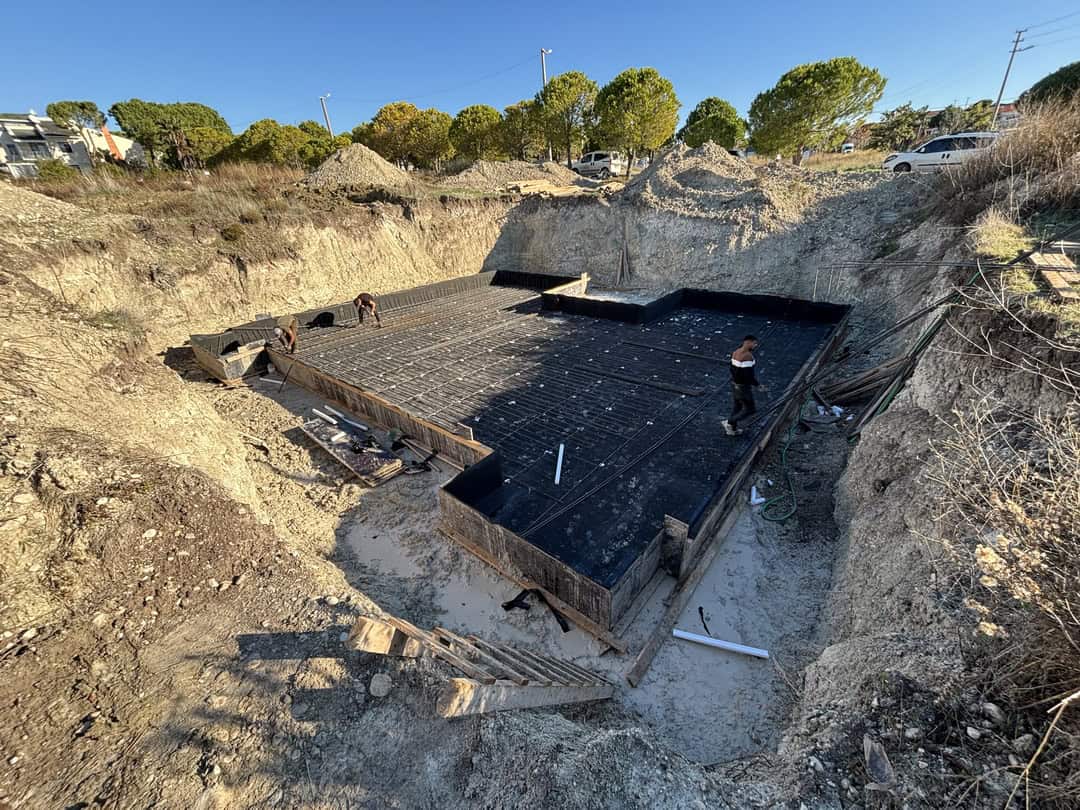
Drainage System: A Complement to Waterproofing
Even insulation made with the right material will eventually fail over time as long as water accumulates against the wall. That is why we design curtain wall insulation to include a drainage panel installed immediately outside the membrane and a drainage pipe at foundation level; the goal is to divert water away without allowing it to exert pressure on the wall. Waterproofing installed without a drainage system may not be sufficient on its own to withstand hydrostatic pressure in the long term. For this reason, we install the waterproofing not as a single material, but as a system consisting of a membrane, drainage, and proper joint details.
The Material Selection Process at İmerek Yapı
Since we carry out the structural construction work without subcontractors—using our own team and our own formwork system—the waterproofing application is not a separate task delegated to an outside team, but rather a process supervised by the same team on the same site. Our zero-tolerance approach to material selection and construction chemicals is based on the principle of “not the cheapest, but the right choice”; because basement waterproofing is one of the construction elements where errors may not surface for years and where repairs are the most difficult to perform.
We planned the waterproofing right from the very beginning of the structural work Rough Construction We consider it an integral part of our process; our general approach Waterproofing in Buildings You can also find this information in our article. If you’d like to discuss waterproofing materials and details for your villa project, you can contact the İmerek Yapı team by calling +90 545 732 64 44 or emailing [email protected].

