




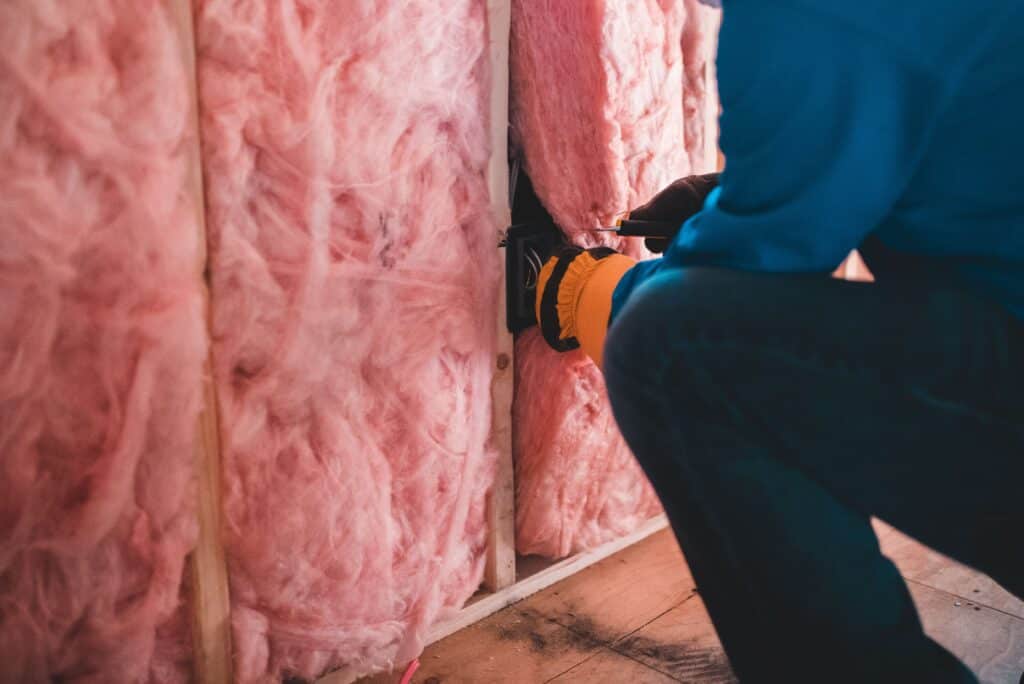
The most common mistake in sound insulation is limiting the discussion to the question “Is there insulation or not?” and overlooking the questions “Which material? In which layer? And with what degree of continuity?” In reality, acoustic comfort does not stem from the quality of a single product; rather, it arises from the seamless continuity of interconnected layers—from floating floor systems to acoustic strips, from vibration isolators to the order of installation. Why Sound Insulation Is Critical in Villas We’ve covered this before; in this article, we’re taking the topic a step further and focusing on the details of materials and application.
Floating Floor Systems: How to Block Impact Noise Between Floors?
The most common noise complaints in villa projects involve impact sounds, such as footsteps and the scraping of objects, coming from the floor above. Since these types of sounds are transmitted structurally through the floor rather than through the air, the solution lies not in wall thickness but in the floor construction details. In a floating floor system, a flexible acoustic insulation board is first applied over the load-bearing concrete, followed by a separating film that surrounds the board, and finally a screed layer on top; the critical point is that the screed layer must not come into direct contact with walls, columns, or plumbing pipes. The moment this separation gap between the screed and the surrounding structural elements is filled, the floor ceases to “float,” and the entire system turns into a sound bridge.
Acoustic Tape and Wall-Floor Joints
Another detail just as important as the floating floor itself is the edge points where the floor meets the walls and columns. The acoustic tape applied to these edges is secured to the surrounding surfaces before the screed is poured, thereby isolating the floor from contact with structural elements. The same principle applies to shared walls between wet areas and bedrooms: just as important as the mass of the wall material is ensuring that the joints between the wall, floor, and ceiling are sealed with elastic caulk. Gaps left at the points where plumbing pipes pass through walls and floors must also be addressed with the same care; embedding a pipe directly into the concrete creates an invisible but permanent sound bridge.
Vibration Isolation in Mechanical Equipment
Equipment such as generators, heat pumps, and pool circulation pumps generate vibration-induced noise that travels through the structure rather than through the air. Vibration isolators (rubber or spring-type mounts) installed beneath this equipment prevent vibrations from being transmitted to the structural system; the use of sound-absorbing cladding on the walls of the equipment room helps control both vibrations and direct sound transmission. Positioning mechanical spaces so that they are not adjacent to living areas—ideally in a separate building or at least with a reduced number of shared walls—is a planning decision that takes precedence over material selection.
Why Isn't Choosing the Right Material Enough on Its Own?
Just as with waterproofing, we evaluate materials for sound insulation based on our zero-tolerance approach to construction chemicals: it is not the product’s label, but its density, flexibility, and tendency to degrade over time that are the determining factors. However, even the highest-performing acoustic panel will not deliver the expected results if the installation process is interrupted at any point. Since we carry out the rough construction work without subcontractors—using our own team and our own formwork system—we plan decisions regarding floating floors, acoustic tape, and vibration isolation right at the start of the project, along with all other insulation details. Our goal is that when we deliver a villa, the homeowners never have to worry about noise coming from the floor above or through adjacent walls.
We planned the sound insulation right from the very beginning of the structural work Rough Construction We consider it an integral part of our process; we take the same approach Waterproofing in Buildings You can also find this information in our article. If you’d like to learn more about soundproofing materials and installation details for your villa project, please contact the İmerek Yapı team: +90 545 732 64 44 / [email protected]

